
· by Michael Blair, Nashville's Mover
The sale closes on the fifteenth and the purchase closes on the twenty-eighth. The lease ends before the house is ready. The new build slips a month. A gap between homes is common, and the question is where the contents of a house go in between. There are three usual answers: the moving company holds it, you rent a storage unit, or a portable container sits somewhere. They differ in how many times the goods are handled, who is responsible for them, and how easy it is to get at something in the middle. Our storage and load-only service exists for exactly this gap between closings; this post is about choosing among the three.
How does storage in transit work?
Storage in transit is the mover’s answer: the crew loads the truck as for any move, but instead of delivering, the goods go into the mover’s warehouse and stay there until the delivery date. On a move across state lines, which covers many of our long-distance moves, it is a regulated service, and 49 CFR 375.609 sets what the mover must do when a storage-in-transit period is about to run out. The longest stay allowed is whatever the mover’s tariff says, so ask for that number before you book.
The same company that packed and loaded delivers. Under 49 CFR 375.201 an interstate mover is liable for loss or damage during the transportation and the related services listed on the bill of lading, so the inventory and the coverage stay with one company while the goods wait. That changes when the stay outlasts the agreed period or the tariff limit: the goods convert to permanent storage, the mover’s liability ends, and the warehouse’s own rules and charges take over. The mover has to tell you in writing at least 10 days before that date, and you then have nine months from the conversion to file a claim for damage done in transit or during storage in transit.
A move that stays inside Tennessee falls under the state rather than the federal rule. Tennessee Department of Safety rule 1340-06-01-.13 covers estimates of charges and claims for loss or damage by household goods movers in intrastate commerce, so on an in-state move ask the mover how its storage terms and its claims process work.
The advantages are one contract, one point of responsibility and goods handled by the people who packed them. The disadvantages are cost and access. Ask how the storage is charged, and whether you can get to a box in the warehouse before delivery and what that costs; companies differ. Storage in transit suits a gap where you do not need anything in the meantime and the stay fits inside the mover’s limit.
When does a self-storage unit make sense between homes?
Renting a unit and having the movers deliver there, then load from there later, gives you access whenever the facility is open, and on a long gap it is worth pricing against warehouse storage. It is also two moves: the goods are loaded, unloaded into the unit, loaded again and unloaded again, and each handling is a chance for damage. The mover’s liability follows the services on the bill of lading, and goods sitting in a unit you rent are not in the mover’s care, so check what the facility’s insurance and your own policy cover for the weeks in between. Our post on what moving coverage actually pays goes further into valuation.
Then there is the heat. NOAA’s 1991-2020 climate normals for Nashville International Airport put the average July high at 90.9°F and the August high at 90.4°F, and an unconditioned unit sits through those months with no cooling at all. Photographs are the clearest case: the Library of Congress guide to caring for photographs asks for a relatively dry, cool and stable place, 30 to 50 percent relative humidity at 70°F or below, and warns against attics, basements and other spots with wide swings. We put photographs, papers and anything you could not replace in climate-controlled space or in your car, give wood furniture and electronics the same steady space when we can, and treat climate control as more important the longer the gap runs. Moving day in that heat is a separate problem, covered in moving in a Middle Tennessee summer.
Size the unit from the mover’s numbers. 49 CFR 375.401 has an interstate mover give a written estimate of the charges, and a non-binding estimate is built on the estimated weight or volume of the shipment; ask for that figure and take it to the storage facility. An undersized unit means a second unit at the last minute.
- Short gap, nothing needed in between, inside the mover’s limit: storage in transit
- Longer gap, need access: climate-controlled self-storage, priced against the warehouse
- A driveway or a lot to put it on: a portable container
- Any option: the coverage, and the date it starts and stops
How does a portable moving container work?
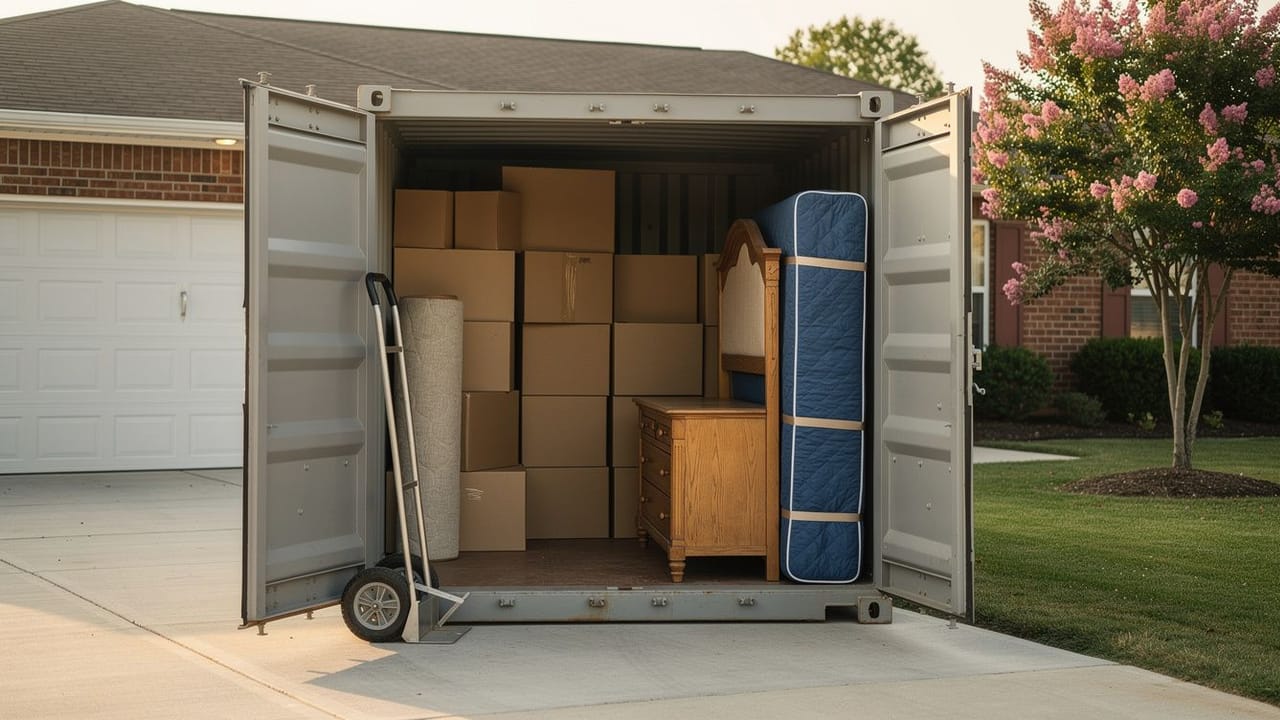
A container is dropped in the driveway, loaded over days, picked up and stored at the company’s yard, and delivered to the new address to unload. The goods are handled twice, into and out of the container, which is fewer times than a self-storage unit. Loading it yourself is the budget version; a moving crew can load and unload it for you.
The constraints are space and rules. The container needs a flat, accessible spot. If you live under an HOA, read what it says about a container in the driveway and for how long, and if the container would sit on the street, ask Metro Codes or your city whether it needs a permit. Whether you can get into it at the company’s yard, and on what terms, depends on the company. Containers are unconditioned, so the same cautions about summer heat apply to a long gap.
Making the gap easier
Whichever route, separate what you will need during the gap before the movers arrive: clothes for the interval, documents, medications, chargers, a few kitchen basics, whatever the children and the pets need. That goes in the car, not the truck, and it should be labeled as staying out even when the crew is moving fast. A box you need from the back of a loaded warehouse may stay out of reach until delivery day.
Ask the mover to walk you through where coverage starts and stops in the option you choose; on an interstate move the same federal rule requires the mover to disclose the limits of its liability in a clear and concise way. Get the storage charges and the redelivery charge in writing. If the gap grows, as gaps do, ask what a longer stay costs, what the storage limit is and what happens to the coverage when it is reached. When you know your dates, ask us for a written estimate and tell us how many days the goods need to wait.
Sources
- eCFR, 49 CFR 375.609, What must I do for shippers who store household goods in transit? — Storage in transit regulated for interstate moves; maximum period set by the tariff; written notice at least 10 days before expiry; conversion to permanent storage ends the mover’s liability; nine-month claims window
- eCFR, 49 CFR 375.201, What is my normal liability for loss and damage? — Liability covers transportation and related services on the bill of lading; mover must disclose the limits of its liability
- eCFR, 49 CFR 375.401, Must I estimate charges? — Written estimate of charges; non-binding estimate based on estimated weight or volume
- Tennessee Department of Safety, Rules chapter 1340-06-01 (2021) — Rule .13 covers estimates and loss or damage claims for intrastate household goods movers
- NOAA NCEI, 1991-2020 monthly climate normals, Nashville International Airport — Average July high 90.9°F, August high 90.4°F
- Library of Congress, Care, Handling, and Storage of Photographs — Dry, cool, stable storage at 30 to 50 percent relative humidity and 70°F or below; avoid attics and basements
FAQ
Storage When the Closing Dates Do Not Line Up — questions
What is storage in transit?
Goods loaded by the moving company and held in its warehouse until the delivery date, under the same bill of lading as the move. On an interstate move the mover has to warn you in writing before the storage period ends, because at that point the goods convert to permanent storage and the mover’s liability ends. It suits a gap where you do not need access to anything in the meantime.
Is it cheaper to use a storage unit between houses?
It depends on the length of the gap and the prices you are quoted, so get both. A unit gives you access, but it adds two handlings of everything, and goods in a unit you rent are not in the mover’s care, so check the facility’s insurance and your own policy. In a Nashville summer, climate control is worth paying for anything heat and humidity can harm, photographs first.
Can I get something out of storage while my things are held?
With a self-storage unit, whenever the facility is open. With a mover’s warehouse or a container yard, it depends on the company, and the item has to be findable, so ask before you book. Pack a labeled gap kit and keep it with you instead.
Do I need climate controlled storage?
For anything heat and humidity can harm over a Nashville summer, yes: an unconditioned unit sits through average highs above 90°F in July and August with no cooling. Photographs, papers and irreplaceable items need it most, and wood furniture and electronics benefit; the longer the gap, the more it matters.